
Acupuncture for Anxiety & Depression in San Diego
Classical Chinese Medicine for IBS, Bloating, Reflux & Gut Health
Your gut knows things your mind doesn't want to admit. That knot in your stomach when something feels wrong, the nausea before a difficult conversation, the way stress sends you running to the bathroom. In Classical Chinese Medicine, your digestive system isn't just processing food. It's processing everything you take in from the world, including information, experiences, and emotions you haven't fully digested.
Gateway Acupuncture & Wellness treats digestive disorders by addressing why your gut is struggling in the first place. Not just what you're eating, but what you're holding, what you're trying to assimilate, and what your body is trying to tell you through bloating, pain, reflux, or irregular bowel movements.
Why Your Gut Responds to Everything
Your stomach has a function most people don't know about. It governs your "gut feeling," your preferences, your instinctive sense of what's right or wrong. It has no judgment, no rationalization. It just knows.
When you ignore that knowing, when you suppress what you're really feeling, when you force yourself to accept situations that don't sit right with you, your stomach holds it. The rational mind tries to override the gut's wisdom ("I should be fine with this," "It's not that bad," "I'm overreacting"), but the body doesn't lie. The gut tightens, bloats, rebels.
Your spleen (also the pancreas), in Chinese medicine, controls your thoughts. When it's functioning well, thinking is productive, you can learn skills, form useful habits, make decisions. But when the spleen system becomes overwhelmed (from overthinking, from trying to rationalize away what your gut is telling you), thoughts become obsessive. You can't stop analyzing. Emotions feel like they have no closure, no resolution. And physically, this shows up as sharp pains in your intestines, bloating that won't quit, or that drum-like distention that makes you feel like your due date is coming up in three months.
What Happens When You Can't Digest Your Life
Think about what digestion actually does. You take in food, your body separates what's useful from what needs to be eliminated, absorbs nutrients, and releases waste. Your small intestine literally makes these distinctions thousands of times a day. What stays, what goes.
But this system doesn't just work on food. It works on everything. Information. Experiences. Relationships. Stress. When life throws more at you than you can process (too much of the wrong food, too many demands, too much stimulation, too many difficult emotions), your digestive system responds exactly as if you'd eaten something you can't break down. It gets stuck.
The large intestine's job is assimilation. Taking in experience beyond just the immediate moment (which is the lungs' job through breath). When you're forced to assimilate too much too fast, when there's too much activity and not enough time to integrate it all, the system shuts down. You get constipated, literally and metaphorically. Or the opposite happens, if your body has enough fluids it may choose to purge and everything moves through too fast, incomplete, undigested.
Your small intestine is your discernment system. It's supposed to help you know what to keep and what to let go, what's nourishing and what's toxic. But when this system fails, you doubt everything. You can't tell if this food is okay, if this relationship is healthy, if this job is sustainable. The physical symptom might be diarrhea, urgency, incomplete digestion. The emotional symptom is constant second-guessing, seeking feedback from others because you can't trust your own knowing anymore.
The Inflammation Pattern
IBS. Crohn's. Ulcerative colitis. Gastritis. These aren't separate diseases that randomly appeared. In Classical Chinese Medicine, they're all expressions of Heat that has moved inward, became trapped, and manifesting as inflammation.
Here's how it happens: Something irritates your digestive system. Could be a pathogen (food poisoning, processed food, pesticides, gut infection), could be stress, could be long-term suppression of emotions, it could even be a chaotic home environment since the digestive organs also related directly to your sense of Home. Your body's first response is to try and push it out. But if you don't have enough resources (enough sleep, enough fluids, enough digestive strength), the pathogen or irritation can't be fully expelled. So your body does the next best thing. It walls it off, creates inflammation around it to contain it, keeps it away from your the other vital organs.
In the short term, this is protective. In the long term, this becomes the disease. The inflammation becomes the new normal. Your gut lining stays irritated. Your immune system stays activated. Your digestion stays compromised.
Most treatments try to suppress the inflammation (steroids, immune suppressants) or avoid triggers (elimination diets). The medicine quiets the critical warning system the body has issued as a clue of major dysfunction. But they don't ask: Why is the inflammation there? What is your body trying to protect you from? What hasn't been fully processed and released?
The Stress-Gut Connection You Already Know
You've probably noticed your digestive symptoms get worse when you're stressed. This isn't coincidental or "all in your head." Your digestive system and your nervous system are inseparable.
When you're in fight-or-flight mode (which, let's be honest, is most of modern life), your body diverts resources away from digestion. Blood flow goes to your limbs so you can run. Digestive enzymes decrease. Gut motility either speeds up (urgent diarrhea) or slows down (constipation). Stomach acid increases (reflux) or decreases (bloating, feeling full after tiny meals). Further more, most people are eating on the run, drinking ice-cold drinks, consuming a greater quantity of processed foods, eating too much raw foods, or otherwise unknowingly engaging in behaviors that work against their digestive health.
What most people don't realize is that the gut-brain connection works both ways. A compromised digestive system also affects your mental state. When your gut is inflamed, bloated, in pain, your nervous system can't relax. You can't shift into "rest and digest" mode because your digestive system is sending constant distress signals.
You might have noticed you feel more anxious, more irritable, more foggy-headed when your gut is acting up. That's not a coincidence. In Chinese medicine, the spleen (digestive system) is what allows you to think clearly, to focus, to feel grounded in your body. When spleen function is compromised, your mind scatters, you can't concentrate, you feel unmoored.
How Classical Acupuncture Treats Digestive Disorders
Classical Chinese Medicine doesn't treat IBS. It doesn't treat reflux or constipation or bloating as isolated symptoms. It asks: What pattern in your body created this? What system is overwhelmed? What hasn't been processed?
The treatment depends on what we find:
If your stomach is holding suppressed emotions: Feelings you've been denying, experiences you've been trying to push down. We release these holdings from the blood vessels in your digestive system. Many patients describe sudden emotional clarity during or after treatment, old grief or anger surfacing, finally able to be processed and released instead of stuck in the gut.
If your spleen system is overwhelmed from overthinking: Obsessive worry, mental loops you can't break, trying to rationalize away what your gut knows is true. We calm the obsessive thinking, restore your ability to trust your instincts, help your body distinguish between productive thought and spinning.
If your small intestine has lost its discernment: You can't tell what's nourishing and what's toxic anymore, physically or emotionally. We restore that system's ability to make clear distinctions. Keep this, release that. Simple.
If your large intestine is shut down from overwhelm: Too much to assimilate, too much stimulation, chronic stress that never lets up. We help your body process what's been backed up, restore normal motility, teach your system it's safe to release what doesn't serve you.
If there's chronic inflammation: Heat lodged in the organ membranes (gastritis, colitis, enteritis). We address the underlying pattern that created the Heat, help your body complete what it's been trying to do all along (expel the pathogen or irritant), reduce the need for protective inflammation.
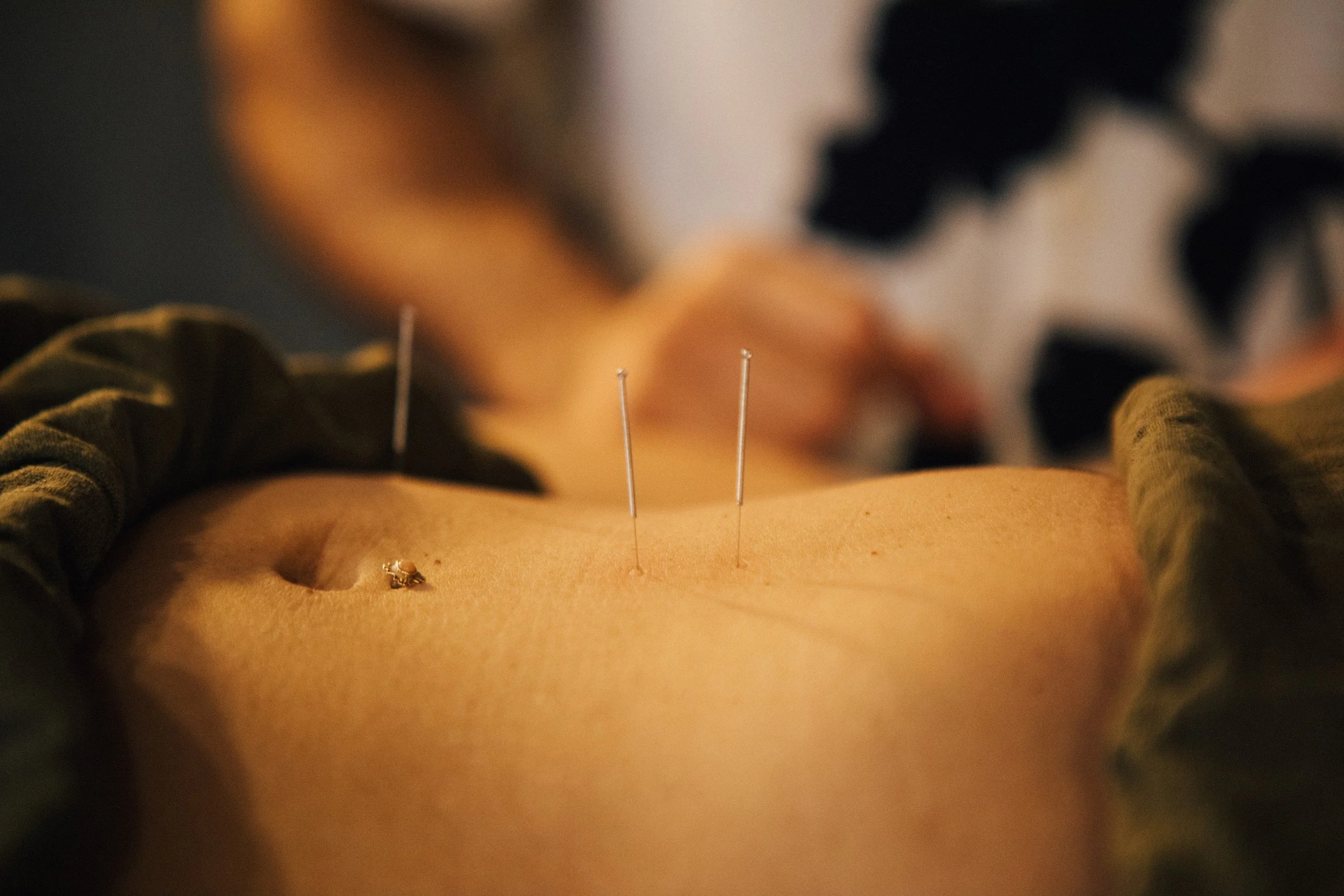
The treatment might involve thin needles along specific digestive pathways, sometimes gentle techniques like moxa (warming herb) to restore digestive fire, sometimes releasing visible vessels near key points to drain excess Heat or stagnation. It's simple. Direct. Addressing the root.
What Changes Look Like
The shifts often surprise patients because digestive symptoms they thought were "just how their body works" start to normalize:
Bloating decreases. That chronic distention after meals, the feeling of being six months pregnant from a salad, starts to ease. Your abdomen feels flatter, softer. You can breathe deeply again without restriction.
Bowel movements regulate. Whether you've been constipated for years or dealing with urgency and diarrhea, things start to normalize. You develop a predictable pattern. No more desperate searches for bathrooms or going days without a movement.
Pain resolves. The sharp pains in your intestines, the cramping, the reflux burning in your chest, the constant low-grade discomfort all begin to fade. You forget what it's like to be in pain after eating.
Food tolerances expand. Foods that used to trigger symptoms become manageable again. You're not stuck eating the same five safe foods forever. Your gut becomes resilient enough to handle normal variety.
Mental clarity returns. The brain fog lifts. You can focus again. The obsessive worry decreases. You feel more grounded, more present, more able to trust your own judgment.
The stress-gut cycle breaks. Stress stops sending you immediately to the bathroom. Your gut becomes less reactive, more stable. You build capacity to handle life's demands without your digestion falling apart.
Most patients notice meaningful improvements within 3-4 weeks of weekly treatment. Chronic inflammatory conditions (IBS, IBD, long-term reflux) typically require 2-3 months for deeper constitutional shifts.
What Patients Are Saying
"I've had IBS for over a decade. Tried every elimination diet, every probiotic, every medication my gastroenterologist could prescribe. Nothing worked for more than a few weeks. Diego explained how my gut was holding unprocessed stress and grief from a difficult period in my life. After two months of treatment, my bowel movements are normal for the first time in a while."
— Rachel K., North Park
"The reflux was so bad I was sleeping propped up on pillows, waking up with constant acid in my throat. My doctor wanted to raise the dose of my PPIs but they were already making me feel worse. Diego treated the Heat pattern driving the reflux. Three weeks in, I was sleeping flat again."
— James T., University Heights
"What shocked me most was realizing how much my digestive issues were connected to suppressing what I really felt about my job, my relationships, my life. As the treatment helped me release those feelings, my bloating and constipation improved, I had the clarity to make changes I'd been avoiding for years."
— Maria S., Hillcrest
Who This Approach Serves
Classical acupuncture for digestive disorders is particularly effective for people who:
Have been diagnosed with IBS, IBD, GERD, colitis, gastritis, Chron’s disease or other chronic digestive conditions
Experience symptoms that worsen with stress or emotional upset
Have tried elimination diets, medications, and supplements with limited lasting results
Notice their digestion affects their mood, energy, and mental clarity
Deal with bloating, pain, irregular bowel movements, or reflux that interferes with daily life
Want to address root causes rather than just manage symptoms indefinitely
Have gut issues alongside anxiety, overthinking, or difficulty making decisions
Your First Visit: What to Expect
Initial Patient Intake & Treatment (80 minutes | $225)
Your first session includes:
Comprehensive health and digestive history including what you've tried, what's worked (even temporarily), and what makes symptoms better or worse
Classical diagnostic assessment using pulse and tongue reading to understand the pattern creating your digestive issues
Discussion of your story, symptoms, stress patterns, and what you're hoping will change
Personalized treatment plan addressing your unique digestive pattern (not a generic IBS protocol, but treatment specific to what your body needs)
First acupuncture treatment
Follow-Up Treatments (55 minutes | $180)
Most patients begin with weekly sessions. The first few treatments often focus on calming inflammation and regulating nervous system response to stress. As symptoms stabilize, we address underlying constitutional patterns and emotional holdings contributing to digestive dysfunction. We space sessions out over time as your system regains resilience.
Frequently Asked Questions
How long does it take to see results?
Many patients notice improvements in bloating, pain, or bowel regularity within 4-5 weeks. Chronic and long-standing inflammatory conditions like IBD or IBS typically require 3-6 months of consistent treatment for meaningful, lasting change. The goal isn't temporary symptom suppression but restoring your digestive system's fundamental ability to be independent and function well. For many patients, a modification to their lifestyle and dietary habits greatly improves the healing process.
Can acupuncture help if I've tried everything?
Yes. We often work with patients who have tried multiple medications, strict elimination diets, probiotics, and supplements without lasting resolution. Classical acupuncture addresses the systemic patterns keeping digestive issues stuck, often the piece other approaches miss.
Will I have to avoid foods forever?
Our goal is to rebuild your digestive resilience, not restrict you indefinitely. Some people benefit from temporary dietary modifications during treatment, but we're working toward your body being able to handle normal food variety without constant symptoms. We want to restore function, not manage dysfunction long-term.
Can I continue my medications?
Absolutely. Continue all prescribed medications unless your doctor advises otherwise. Many patients are eventually able to reduce or discontinue medications under medical supervision as their digestive function improves, but we never recommend stopping prescribed treatments without physician oversight.
What about probiotics and supplements?
Continue what you're taking. Some patients find they need fewer supplements as their digestive function improves and they can actually absorb nutrients from food again. We'll discuss what might be helpful as we see how your system responds to treatment.
Do you take insurance?
We operate as a cash-pay practice but provide detailed superbills that you can submit to your insurance company for possible reimbursement. Many insurance plans cover acupuncture for digestive conditions.
Ready to Begin?
Schedule your initial consultation to explore how Classical Acupuncture can restore your digestive health.
Complimentary Consultation: 15 minutes
Initial Intake & Treatment: 80 minutes | $225
Follow-Up Treatments: 55 minutes | $180
Located in Hillcrest, San Diego
Gateway Acupuncture & Wellness
Diego García, L.Ac.
3636 5th Ave, Suite 101
San Diego, CA 92103
Serving: Mission Hills, Mission Valley, Hillcrest, North & South Park, Golden Hill, Normal Heights, Kensington, University Heights, Bankers Hill, Downtown San Diego, and nearby communities.