Identity & Healing · 10 min read · June 2026
Walking between worlds.

The short of it
I spent years unlearning a shame that was never mine, until I understood I was born exactly as I should be. Growing up gay meant pressure to conform. Coming here from Venezuela meant a steeper climb. Both made me the healer I am. That understanding is why I built this practice in the heart of Hillcrest. This is that story, and why the people who never fit the mold so often become the ones who heal.
I knew early.
I have known I was different since the fourth grade. I was a kid decorating his mom's Donna Summer cassette tape with stickers, dancing with and asking my cousin if she thought my slightly sunburned cheeks looked cute because at the time I thought it looked like natural blush. I was born in Venezuela and lived there until I was eleven, an only child who kept mostly to himself, his Legos, and the graveyard of electronics he took apart to see how they worked. My family was artistic, loving and accepting, so I was allowed to be quirky, to live in my own world. The question of who I was did not press on me yet.
Then we moved to the States, and the feeling of being an outsider arrived in two languages at once. I was an immigrant, learning a new culture. And inside, as I grew, I was noticing boys in a way I had been taught was wrong. Perhaps this is why I kept my circle small. It was also easy to hide my orientation because I was the new kid from somewhere else.
I lost my voice.
In high school I did something that still surprises me. I ran for class president. I was an unlikely candidate. I had come into the social world late, an immigrant still learning the rhythms of the place, and my family did not have much. I rode the school bus throughout all of high school and ate free lunch too. I was not in the cool crowd by any stretch. I also wasn't athletic or a jock. If anything, I guess I was nerdy. I was running against a guy who had social influence and an established family behind him, who drove a nice car and seemed to move through a world that had promised that everything was within reach. At the time I was sure the lives of those in the in-crowd were as easy as they looked. Healing work has taught me since that the grass isn't always greener on the other side. But I wanted to be seen, so the foreign, quiet, awkward kid made his case for heart and integrity. I still had the yearning to lead, climb to greatness, and be seen.
Knowing my odds were slim, I planned a small piece of theater. I would open with a dull, over-scripted speech, then feign a sudden rush of courage, crumple the page, throw it to the floor, and finish from a second speech I had tucked away, as if the words were rising straight from my heart. The room rose with them. They were cheering the real me, the one who had finally spoken up. The cheering ran long, and in the thrill of it I looked down at the podium and found bare wood. I had thrown away both speeches.
My knees locked. The sweat came. Time did not freeze so much as march in place, every silent second another proof that I was a fraud with nothing worth offering. I walked to the ball of paper, picked it up, smoothed it flat, and finished with my tail between my legs. The second round of cheering had a different sound than the first. After that I learned the lesson a tender heart learns too easily. Keep the voice caged. Do not want too much. Do not let them watch you reach.
I hid in plain sight.
For a long time I made academics my armor. If I could not be just like the guys I looked up to, maybe I could be seen for other reasons. Because I loved to spend time in my head, academics was easy at first. In high school, it didn't take great effort to graduate near the top of my class, I was part of an engineering school and helped start a robotics program that competes nationally now, and won a full scholarship to study engineering at the University of Florida. Then the math humbled me, and an advisor told me, in no kind terms, that I was not cut out for it, that I should reconsider my life. I left her office in tears. The pressure to come out in college was at its peak and I had already been doing a fine job of generalized self-doubt on my own.
What I could not see then was that I had traded one set of gifts for another's approval. I loved to build, to dream, to design. I loved the living sciences, biochemistry, the body, food. I left engineering and I found my way to nutrition, and eventually further still, to a medicine that turned out to be the thing I had been circling all along. The detour was an integral part of my own self-discovery and added important layers to who I am today.
Coming out, and my mother.
I eventually came out in college, far enough from home that I could finally stop performing. I came out to myself first, then to a few close friends. My mother, as mothers do, sensed it before I said it. She asked me plainly, on a drive back from summer break, whether I liked girls or boys, and I told her it was a hard question to answer. It was not hard. It was only hard to keep telling her what she wanted to hear.
She cried. She wondered, the way many parents of her generation did, whether she had done something wrong. We went through a lot of healing together in the years and decades after. She had to let go of the vision of who her only son would be to actually see me as I was. Some of that vision had been a weight on me: be groomed, be sharp, be high-achieving, be strong, carry yourself a certain way. I cannot lay all of that at her feet. I took it on too, and I am still unwinding parts of it through my own alchemy work. But she did the bravest thing a parent can do. She changed. She came to see the fears and the shame she had passed down, she apologized, she grew, and she even started a PFLAG chapter in my hometown. Today she would fight anyone who said an unkind word about me or my family. We are closer than we have ever been.
The shame I carried was never mine to begin with. It was handed down, and I agreed to carry it. Transformation is about authentically choosing your agreements.
Unlearning the shame.
The shame did not leave all at once. I remember walking past a screening of Rocky Horror in college, precisely during Dr. Frank-N-Furter's performance of "Sweet Transvestite" and thinking, that's not for me and at least I am not like one of those gays. I remember a party at my uncle's while visiting him in Paris, his gay mountain biking club friends in playful wigs, and thinking it again. That was internalized homophobia talking, the kind you absorb from a family, a country, a lifetime, without ever agreeing to it. It dressed itself up as taste, as masculinity, as the voice that said do not let your wrist go limp.
Some of that shame turned on my own body. I had taken in a rule that ran through the gay world I was stepping into, that you could not be both broke and out of shape, that your image was a kind of currency. In graduate school I was certainly broke, so I told myself I could at least manage the other half. For most of a decade I lived with bulimia, using food to numb what hurt and then purging it out of shame. It took a heavy toll on my body, more than I could carry for long, and in time it drove me to seek therapy and to find other ways to hold my pain. Naming it here is not easy. I do it because I know I am not the only one who learned to punish a body for not being enough, and because a healer who pretends he arrived unscarred is not telling you the truth.
If you are caught in something like this now, please know you do not have to face it alone. The National Alliance for Eating Disorders offers a free helpline staffed by clinicians at 866-662-1235, and you can call or text 988 any time for immediate support.
And then, slowly, I let it soften. I wore more color. I took myself less seriously. Watched and loved early RuPaul's Drag Race and took to heart her sign-off: "If you can't love yourself, how the hell are you gonna love somebody else?" I watched a live action showing of Rocky Horror and fell in love with the musical. These days I am at home in both halves of myself, the masculine and the feminine. I own at least seven wigs. My favorite is a dusty pink one I call Sakura. I have done drag a couple of times, and I could mop the Butch Queen First Time In Drag category. None of this is a costume over the real thing. I am able to be authentically me. I can draw with all the crayons in the box. I am the real me, finally unguarded.
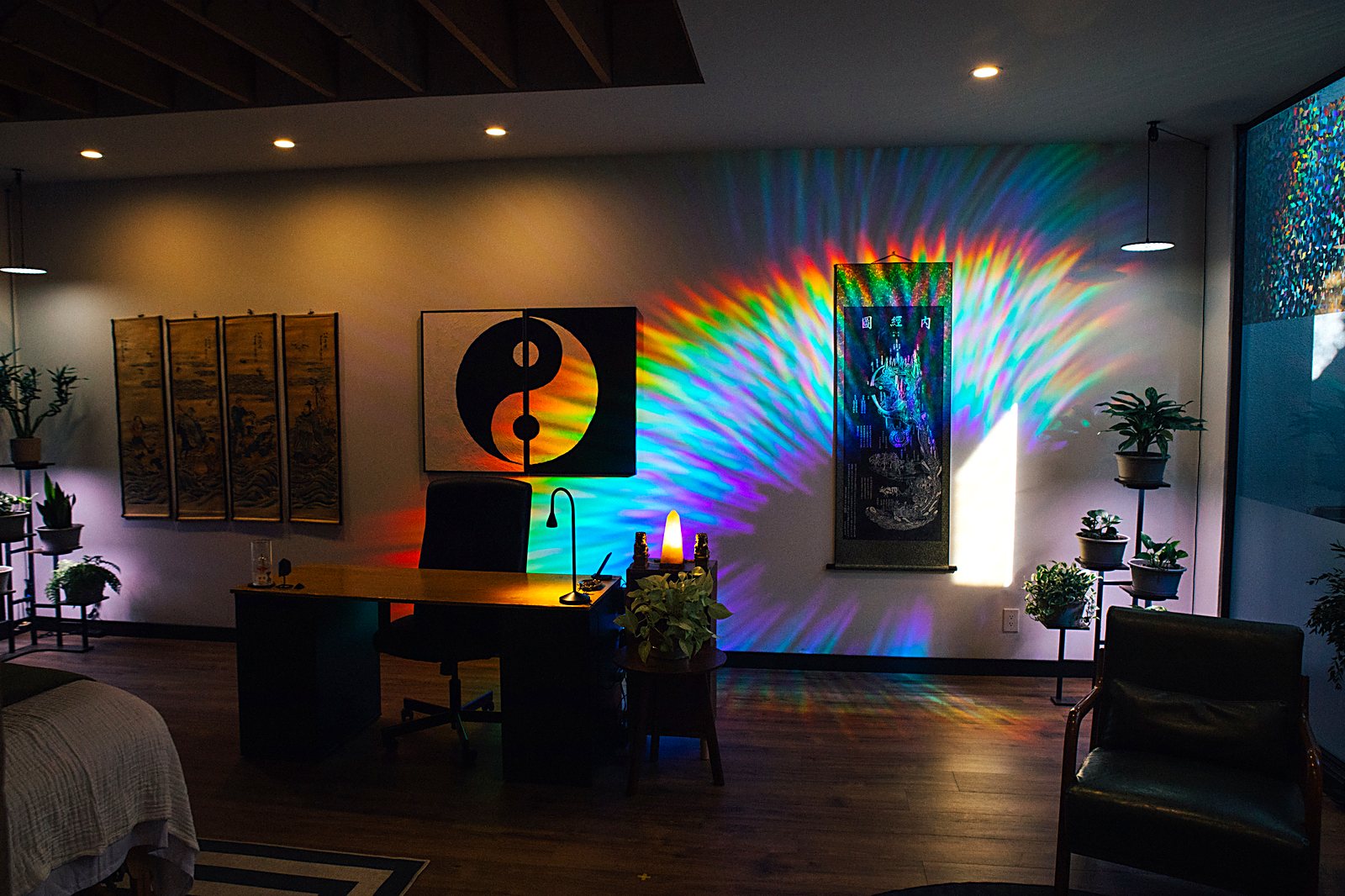
Daoism gave me a frame for what I was learning in my body. Yin and yang are not opposites to choose between; they are a single wholeness in motion. I fitted the windows of my clinic with a prism film, so when the sun comes through it scatters into a full spectrum and the whole healing space fills with color. This phenomenon speaks, to anyone who has ever felt like the exception, that they are welcome here exactly as they are, and that they are perfect and beautiful.
If the writing speaks to you, let the next one find you.
You're in. Check your email to confirm.
Why the ones who don't fit are called to heal.
If you have ever felt broken, or like you do not belong, this is what I most want you to hear. Many of the people who become healers are people who never fit neatly into a box. Across history and across cultures, the ones who lived a little apart, between the categories, were often the ones called to tend the sick and carry the mysteries. There is something about not fully belonging to either side that opens a door to the inner workings of life.
Being different excludes you from the ordinary path. It throws you into adversity early, and it asks you to face yourself again and again. That is really hard and tiring. It is also exactly the training profound healing requires. The grit you earn surviving your own difference is the same grit it takes to sit with another person in theirs, without flinching. I have been walking between worlds my whole life. I have come to understand that walk as the edge my healing works from, and it asks for sincere self-acceptance, tenacity, and a willingness to show up and keep meeting what is difficult.
I think often of that boy at the podium. The voice I learned to cage is the same one that now sits with people in their hardest hours. I can speak easily these days, in small rooms and large ones, and I have led workshops and webinars and given keynotes. Somewhere along the way I understood that my place in this medicine is vulnerability and education, letting myself be seen so the person across from me feels free to be seen too. This sanctuary, and this website, are a beacon for that voice. The deeper a heart has been hurt, the deeper it can love, and the wound I hid for so long became the door into the work.
I do not do this work alone or untethered. I am blessed to share my life with a partner who is also a healer, a psychologist, and together we are raising a family. I am, in other words, a somewhat "ordinary" and happy person who also happens to know the particular weight of being the one who is different.
If you have felt like the exception.
If any of this lands close to home, you are the person I built this practice for. Whether what you carry is shame, the long residue of hiding, the exhaustion of minority stress, or simply the sense that there is more to your life than you have been able to reach, I offer you the door to the work for it. Please remember, like the rainbow, you are whole and perfect as you are. You are welcome here. You can read more about how I work with gay men, or about the deep pattern-clearing of the Thirteen Ghost Points. Or we can simply begin with a conversation.
Did you
resonate
with this?
did too
Set Gateway as a preferred source on Google, so that more of it reaches you.